Skip to content
Created with Sketch.
  • Home
  • Price Check
  • Get A Quote
  • FAQ
  • Products
  • News
  • Contact Us

Tag: medical savings account

DSPs explained: why going out of network can cost you more

Posted on 25th May 2026

“My plan is active, so why did I still pay?” is not a new question to South Africans. You pay your medical aid every month… so why does a bill still land in your inbox?

If you have ever asked that after a doctor visit, scan, or hospital visit, you’re not alone. Many South African medical schemes use provider networks to manage costs and agree on rates. That’s where Designated Service Providers (DSPs) come in.

This guide explains how DSP and network rules typically work, when extra costs may apply if you go out of network, and what to check before you claim.

In most situations, “out of network” doesn’t mean your claim will automatically be rejected. Instead, different rules may apply. For example, there could be a co-payment, a payment limited to the scheme rate, or additional steps like pre-authorisation.

You’ll also find a simple checklist to use when comparing options. That way, you can spot network rules that may matter most to you or your household.

View options to compare the benefits of different medical aids side-by-side before you choose.

What is a DSP in South African medical schemes?

A Designated Service provider (DSP) is a healthcare provider, or group of providers, that has a contract with a medical scheme and is listed in the scheme rules as a preferred provider for certain services.

Your option may guide you toward certain hospitals, doctors, pharmacies, or service providers for services like scans or blood tests. Importantly, whether a provider is “in network” may depend on the specific service you need, not only the provider itself.

DSP vs network provider

You may notice that “DSP” and “network provider” are often used interchangeably in member communication. Some schemes use “network” as the easier term, while “DSP” usually appears in official benefit documents and option rules.

Either way, the practical point remains the same: If your option lists preferred providers for a service, using someone outside that list may change how the claim is paid.

What does “out of network” mean in practice?

When people hear “out of network”, they often think of hospitals first. But network rules can apply to many types of healthcare services.

Depending on your option, this may include:

  • GPs and specialists
  • Pharmacies (including repeat medicine)
  • Pathology and radiology (blood tests, MRI, CT)
  • Referral pathways and authorisation steps

Because networks differ by scheme and option, two people can be on the same scheme and still have different network rules.

Why schemes use networks

Networks help schemes agree on rates and billing processes with specific providers. They also support more predictable care pathways for certain services. Many options use tools like pre-authorisation, protocols, and formularies to guide how care is accessed and paid, especially where costs can escalate quickly.

How going out of network can cost you more

3 common cost outcomes

Going outside your option’s network doesn’t always mean a claim won’t be paid. However, different cost outcomes may apply depending on the scheme rules. Some of these outcomes include the fact that:

1) Co-payments may apply

If your option rules require a DSP or network provider for a service, choosing a non-network provider may trigger a co-payment.

Example: Your option requires a network radiology group for MRI scans. If you book at a non-network practice, a co-payment may be charged, depending on your rules.

2) The scheme pays up to a set rate, and you pay the difference

Many services are reimbursed at a scheme rate (scheme tariff). If a provider charges above that rate, you pay the balance.

Example: A specialist charges above scheme rate. Your scheme pays up to the allowed rate on your option, and the difference may be for your own account. This is sometimes called balance billing.

3) A claim may be reduced if rules aren’t followed

Some options require certain steps before treatment takes place. If these steps aren’t followed, benefits may be affected.

Example: A planned hospital admission may require pre-authorisation. If authorisation isn’t obtained, the claim may be reduced, or a co-payment may apply depending on the rules.

These outcomes aren’t automatic. The exact detail always depends on the scheme rules. But knowing the common triggers beforehand can help you avoid unexpected costs.

View options to see how different options handle network rules, scheme rates, and common co-payment triggers.

Where people get caught out most often

If you’re new to medical schemes, it helps to know that network rules usually appear in everyday healthcare moments, not only during major events. These are situations where members are often surprised by extra costs. Some of these situations include:

Planned scans and diagnostics

MRI scans, CT scans, specialised blood tests, and radiology services are often linked to preferred provider networks. If you use a provider outside the network, the claim may be paid differently.

Specialist visits

Specialists sometimes charge above scheme rate. In addition, some options require referrals or specific pathways before specialist consultations are covered fully.

Hospital admissions

Hospital networks can be strict. Your option may only include certain hospital groups or apply different rules if you choose a non-network hospital for planned procedures.

Medicine and pharmacy choice

Some options require members to use preferred pharmacies or follow a medicine formulary. If scripts are filled outside those rules, benefits may be paid differently.

So, the simplest way to avoid surprises? Check the rule before you book, not after the claim is processed.

Quick checklist: what to check before you book a procedure or get admitted.

Before committing to a provider or procedure, it helps to run through a few key questions:

  • Is this provider in-network for my option and for this service?
  • Do I need pre-authorisation?
  • Do I need a referral to see a specialist?
  • Are there protocol or formulary requirements for this service or condition?
  • What co-payments are listed in the option rules for out of network use?
  • What rate does the scheme pay for this service, and what may be for my account if the provider charges above that rate?

How to compare options on Medicalaid.co.za

When comparing medical aid options, it helps to look beyond the premium. Instead, focus on how each option handles network rules and claims processes.

Here are five things worth comparing:

  • Network and DSP requirements (hospital, pharmacy, day-to-day providers).
  • Authorisation and referral rules (what needs approval and when).
  • Co-payment triggers (especially out-of-network rules).
  • Scheme rates and how provider charges are handled.
  • How clearly the option explains benefits and member responsibilities.

If you’d like to understand these topics in more detail, explore the explainers on the Medicalaid.co.za news page. They cover some of the most common medical aid questions South Africans ask.

View options as the next step for early-stage research, so you can compare medical aids side by side before choosing the one that is best for you.


| Tagged compare medical aid, compare network rules, Dsp, medcal aid, Medical aid, medical savings account, network, scheme rate, young professionals
medical aid

Medical aid for young professionals: What to compare before you join

Posted on 24th April 2026

Starting your career means earning your own income. It also means managing real financial responsibilities. Medical aid is one of the biggest monthly commitments you will make, so choosing blindly isn’t an option as the wrong medical aid choice can unnecessarily cost you thousands over time.

Many young professionals focus on one thing only. Price. However, the cheapest plan is not always the smartest move.

Before joining a scheme, here are seven key considerations every young professional in South Africa should compare carefully.

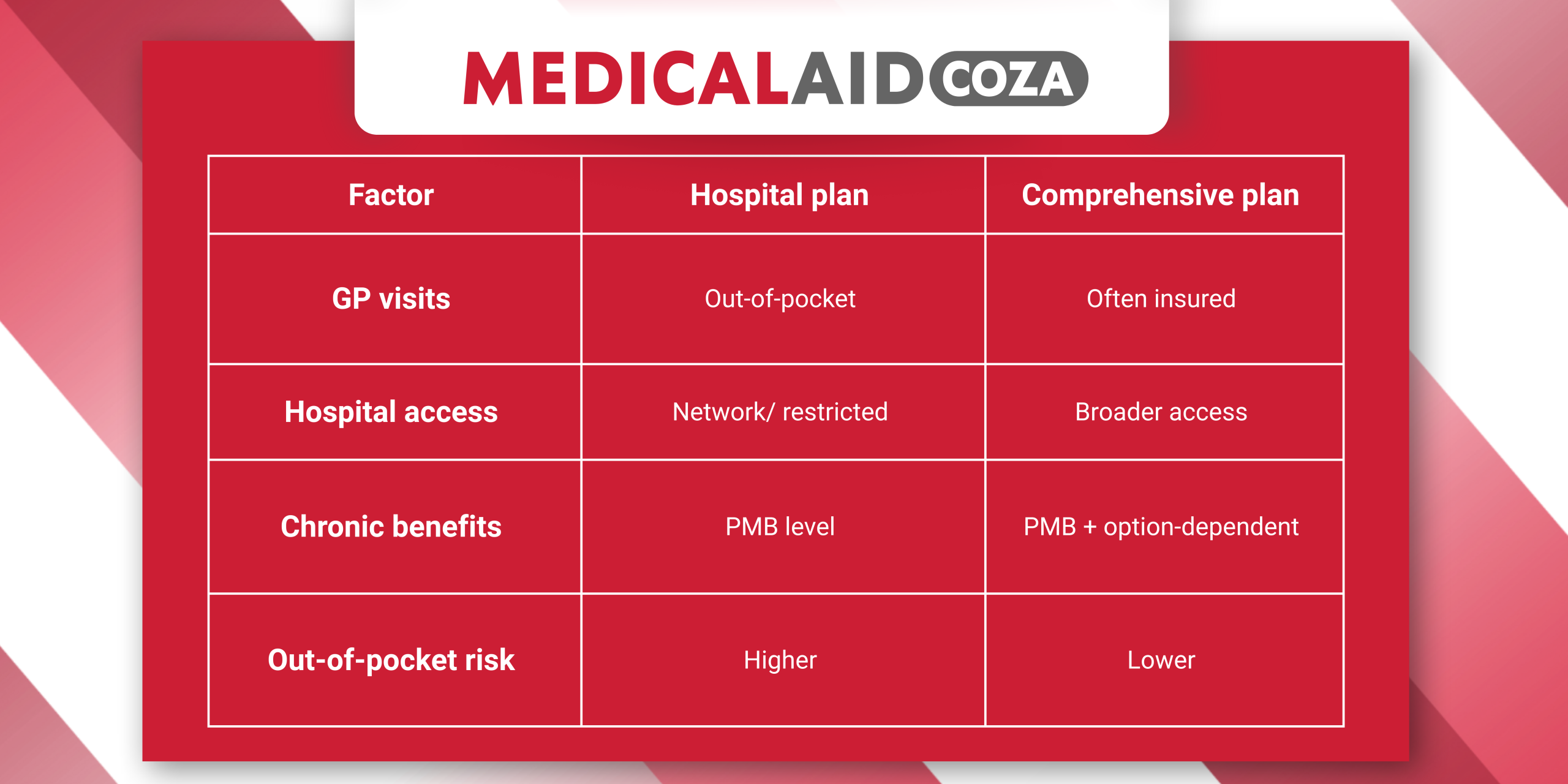
If you are already exploring options, it helps to compare medical aid options online. You can view plans side-by side and see how they differ based on your budget and health needs here. Why guess when you can compare easily in one place for free? So, what should you be comparing exactly?

1. Monthly contribution vs financial risk

First, weigh up what you pay each month versus the health needs you have. Hospital plans usually have lower monthly contributions. However, day-to-day expenses like GP visits are paid directly out of your pocket.

Comprehensive plans cost more monthly. In return, more day-to-day benefits are covered.

The real decision is simple. Do you prefer lower monthly costs with higher out-of-pocket risk? Or higher monthly costs with fewer financial surprises later? Understanding this trade-off is essential when choosing a medical aid in South Africa.

2. Hospital networks and restrictions

Not all hospital benefits are the same. In fact, they can differ more than you think. Many schemes, including Discovery, Bonitas, Momentum and Medihelp, use network hospitals or Designated Service Providers (DSPs) on certain options.

This may mean:

  • Access to specific private hospitals only.
  • Co-payments, often around 30 percent, if you use a non-network hospital.
  • Pre-authorisation requirements before admission.

If you live in a major metro, network plans can work well because several hospitals may be available nearby. In smaller towns, network limitations can be more restrictive.

Therefore, always check which hospitals are included on your specific option. Assumptions often lead to unexpected costs.

3. Medical Savings Account structure

Next, understand how the Medical Savings Account works.

Some plans have no savings component. Others allocate a portion of your annual contribution, often between 10 and 25 percent, into a Medical Savings Account.

It’s important to distinguish between:

  • Medical Savings Account – the member-funded portion.
  • Insured benefits – paid from the scheme’s risk pool.
  • Out-of-pocket expenses – paid directly by you.

On many options, GP visits, dentistry and basic tests are paid from savings first. Once savings are depleted, you pay out of pocket unless the plan includes additional insured day-to-day benefits.

This structure plays a major role in how much financial flexibility you actually have during the year.

4. Chronic benefits (even if you are healthy)

You may feel young and healthy today. But there’s so much more to consider. Many young professionals manage long-term conditions such as:

  • Asthma
  • Depression
  • Hypertension
  • Long-term contraception

Medical schemes must provide PMBs, including the Chronic Disease List, in line with the Medical Schemes Act 131 of 1998.

However, PMBs are subject to:

  • Registration requirements
  • Approved formularies
  • DSP rules

This means medication is not automatically paid unless you follow the correct process. So, do you know how chronic benefits work on the option you are considering? Would you need to register a condition? What happens if you do not? These details matter more than you think.

5. Co-payments and shortfalls

This is one of the most overlooked factors. And yet, it causes the most frustration. Examples include:

  • MRI and CT scan co-payments.
  • Specialist accounts charged above 100 percent of scheme rate.
  • Penalties for not obtaining pre-authorisation.

When a plan says it pays “100% of the scheme rate”, it does not always mean the full bill is covered. Some specialists charge above scheme rates. The difference becomes your responsibility.

So, ask yourself: If a specialist charges more than the scheme rate, can I cover the shortfall?

Understanding this builds realistic expectations. It also prevents nasty surprises later.

6. Waiting periods

If you are joining a medical aid for the first time, or moving from medical insurance to a medical aid, underwriting rules may apply.

These can include:

  • A 3-month general waiting periods
  • Or a 12-month condition-specific waiting periods

Waiting periods are regulated under the Medical Schemes Act and applied according to scheme rules. So, here is the key question: If you needed treatment next month, would it be covered? Always confirm how waiting periods may affect you before joining.

7. Ability to upgrade later

Right now, your budget might be tight. That is normal at the start of your career. However, your income is likely to grow over time.

So, before choosing the cheapest medical aid for young people, check:

  • If the scheme allows internal option upgrades where waiting periods may not apply.
  • When upgrades can take place.
  • How contribution increases are structured.

Flexibility matters just as much as affordability.

Quick comparison framework

Here is a simple way to compare:

This framework helps you compare medical aid for young adults in South Africa more objectively.

So, how do you choose the right medical aid as a young professional?

As a young professional, your goal is not to find the “best” medical aid. That does not exist. Your goal is to find the right balance between affordability and financial protection.

So, what matters more to you right now? Lower monthly costs or fewer financial surprises down the line?

Use our comparison tool and get side-by-side prices and benefits based on:

  • Your monthly income
  • Hospital access preferences
  • Chronic needs
  • Savings structure

View your options today. Because the best time to protect your health and your finances is before you need to.

| Tagged compare medical aid, medcal aid, Medical aid, medical savings account, young professionals
Medical Aid For the elderly

Recent Posts

  • Your mid-year medical aid check-in: 5 things to review before your benefits run out
  • DSPs explained: why going out of network can cost you more
  • Medical aid for young professionals: What to compare before you join
  • Does your current medical aid still fit your needs?
  • When should you upgrade your medical aid?
© Medical Aid 2024 | All rights reserved | Privacy Policy | Terms & Conditions
We make use of cookies to provide you with the best possible online experience. To learn more about how we use cookies and how to clear them, please view our Privacy Policy.